
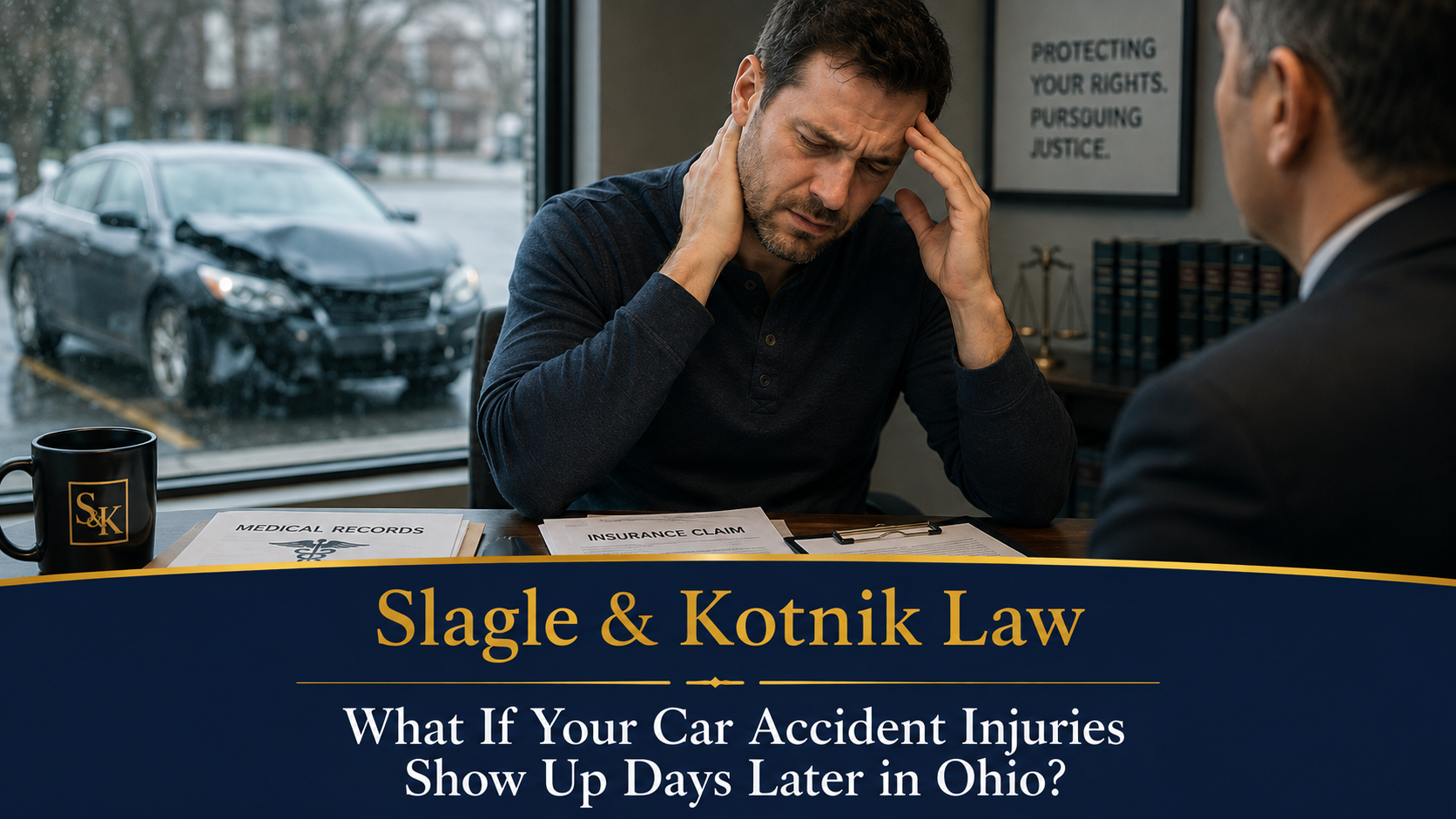
You walk away from a car accident feeling shaken but mostly okay.
Then the next morning arrives.
Your neck is stiff. Your back hurts. You have a headache that was not there before. Maybe you feel dizzy, tired, or simply different than you did before the crash.
Now you are wondering: Can a car accident injury really show up days later, and what does that mean for an Ohio injury claim?
Yes. Some accident-related symptoms may not be obvious immediately.
That does not mean you should panic. However, new or worsening symptoms after a crash should be taken seriously.
Can Car Accident Symptoms Appear Later?
Some injuries do not produce symptoms that you immediately recognize at the accident scene.
A concussion is an important example. The Centers for Disease Control and Prevention explains that some symptoms of a mild traumatic brain injury or concussion can appear immediately, while others may not appear for hours or days.
After a collision, you may initially be focused on getting out of the vehicle, talking with police, exchanging insurance information, arranging a tow, and getting home.
Only later may you begin noticing that something does not feel right.
That is one reason you should continue paying attention to your health after the accident, even if you did not believe you were seriously injured at first.
What Symptoms Should You Pay Attention To?
Every injury is different, and only a medical professional can diagnose what is causing your symptoms.
However, symptoms that develop after an accident may include:
- Headaches
- Dizziness
- Nausea
- Confusion
- Problems concentrating
- Sensitivity to light
- Changes in sleep
- Neck pain or stiffness
- Back pain
- Numbness or tingling
- Weakness
- Increasing pain
The Centers for Disease Control and Prevention identifies headaches, dizziness, nausea, memory or concentration problems, sensitivity to light, and changes in sleep among possible concussion symptoms.
MedlinePlus also recommends seeking medical attention for certain neck symptoms after an injury, particularly when numbness, tingling, weakness, severe pain, or difficulty with movement is involved.
If you experience severe or rapidly worsening symptoms, seek appropriate medical attention rather than waiting to see whether they disappear.
What Should You Do If You Start Hurting a Day or Two After the Accident?
Do not assume that you waited too long simply because you did not go to the emergency room immediately after the crash.
If new symptoms appear, consider getting evaluated by a medical professional.
When you receive treatment, explain:
- When the accident happened
- How the collision occurred
- When you first noticed the symptoms
- Whether the symptoms have changed or worsened
- Whether the pain affects your work or normal activities
Be accurate.
You do not need to exaggerate your symptoms. At the same time, do not minimize them because you are worried about appearing difficult.
Your medical records create an important timeline showing what you experienced and when you sought treatment.
Did You Hurt Your Injury Claim by Waiting to Get Treatment?
Not necessarily.
A person who develops symptoms after leaving the accident scene does not automatically lose the right to pursue an Ohio personal injury claim.
However, a long unexplained gap between an accident and medical treatment can create questions.
An insurance company may want to know when the symptoms began, whether another event could have caused them, and why treatment was delayed.
That is why accurate documentation matters.
If you truly felt fine immediately after the accident but began experiencing pain the next day, say exactly that.
The facts are more useful than trying to make your experience fit what you think an insurance company expects to hear.
Be Careful When an Insurance Adjuster Calls
An insurance adjuster may contact you soon after the accident.
That conversation can happen before you fully understand your injuries.
Suppose an adjuster calls the morning after the crash and asks whether you are injured.
You might answer that you think you are okay.
Two days later, your neck pain becomes severe enough that you schedule an appointment.
The problem is not that you lied. At the time of the call, you may have genuinely believed you were fine.
However, early statements can create unnecessary disputes later.
Slagle & Kotnik has previously warned Ohio accident victims to be careful about giving recorded statements before the full extent of their injuries is known.
You should answer questions truthfully, but you do not have to guess about a medical condition you do not yet understand.
Do Not Rush to Settle Before You Know How You Are Doing
A quick settlement offer can be tempting.
Your vehicle needs repairs. You may already be missing work. Bills are beginning to arrive.
However, an early settlement may come before you know the full extent of your injuries.
Once you sign a final release and resolve an injury claim, you generally cannot go back later simply because your medical condition turned out to be worse than you expected.
Before resolving an injury claim, it can be important to understand:
- Your diagnosis
- Whether you need additional treatment
- Whether you will miss more work
- Whether you may need physical therapy or specialist care
- What medical expenses have already accumulated
- Whether additional medical bills may be coming
If medical expenses are already becoming an issue, read our guide to medical bills after a car accident in Ohio.
Keep Track of How Your Symptoms Change
You do not need to create an elaborate diary.
However, keeping basic notes can be useful.
Write down when a symptom first appeared and whether it became better or worse.
Also keep copies of:
- Medical records
- Medical bills
- Prescription receipts
- Work restrictions
- Physical therapy records
- Insurance correspondence
- Photos of visible injuries
- Records showing missed work
These records can help document how the accident affected you over time.
What If You Already Told the Police You Were Not Injured?
Do not assume that one statement at the accident scene ends the issue.
A police officer asking whether you need an ambulance is dealing with what is happening at that moment.
You may genuinely believe you are fine.
Later symptoms can tell a different story.
If that happens, the important thing is to seek appropriate medical care and accurately explain when the symptoms appeared.
Do not change your story to make it sound better.
Instead, document what actually happened.
How Long Do You Have to Bring an Ohio Car Accident Injury Claim?
Do not confuse delayed symptoms with having unlimited time to pursue a claim.
Ohio Revised Code Section 2305.10 generally requires an action for bodily injury to be brought within two years after the cause of action accrues, although exceptions can apply depending on the circumstances.
You can review Ohio Revised Code Section 2305.10 for the current statutory language.
The important point is that you should not wait for that deadline to approach.
Evidence can disappear. Vehicles get repaired. Witnesses become harder to locate. Memories fade.
If you develop injuries after an accident, dealing with the issue early is usually much easier than trying to reconstruct what happened months later.
You Felt Fine After the Crash. Now You Hurt. What Comes Next?
Delayed pain after a car accident can be confusing.
You may question whether the injury is serious. You may wonder whether the insurance company will believe you. You may even worry that because you initially said you were okay, you no longer have a claim.
Do not make those decisions based on assumptions.
Get appropriate medical care. Keep good records. Be accurate about when your symptoms began. Be cautious about signing insurance paperwork or accepting a settlement before you understand your condition.
Then determine what legal options may be available based on the actual facts of the accident.
Talk With Slagle & Kotnik After an Ohio Car Accident
If you were injured in a car accident and your symptoms did not appear until hours or days later, Slagle & Kotnik Law can help you understand your options.
The firm represents injured people in Massillon, Canton, Stark County, and surrounding Ohio communities.
Call 330-832-9833 or contact Slagle & Kotnik Law to schedule a consultation.
Getting answers early can help you understand your medical expenses, insurance issues, and the next steps in your Ohio car accident claim.
This article provides general information about Ohio personal injury law and is not legal advice. Medical symptoms should be evaluated by an appropriate healthcare professional. Legal deadlines and rights can vary depending on the facts of an individual case.