
After an Ohio car accident, you may worry that a mistake on your part automatically prevents you from recovering anything. That is not necessarily true. Ohio generally allows an injured person to seek damages when another person was also at fault, but the amount available may be reduced by the injured person’s percentage of responsibility.
Shared-fault questions can become important when drivers disagree about who caused a collision. One driver may have been speeding while the other changed lanes. A driver may have failed to signal, while another followed too closely. Weather, visibility, traffic conditions, vehicle damage, and each driver’s decisions may all matter when responsibility is evaluated.
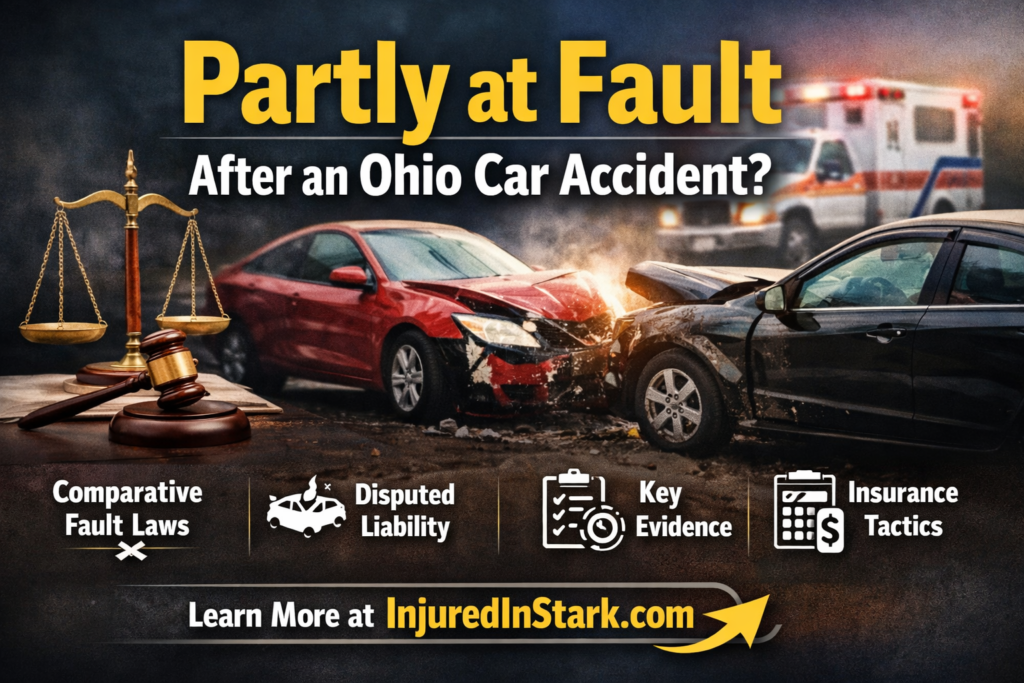
Ohio’s comparative-fault rule
Ohio follows a modified comparative-fault approach in personal-injury cases. In general, an injured person may recover damages when that person’s share of fault is less than the fault of the other parties involved. The damages are then reduced to reflect the injured person’s percentage of responsibility.
For instance, suppose the evidence supports $100,000 in damages and assigns you 20 percent of the fault. A calculation based on that percentage would reduce the damages by $20,000, leaving $80,000 before other issues in the claim are considered. If your share of fault reaches 51 percent or more, Ohio’s rule generally prevents recovery against the other responsible party.
The exact application of the law depends on the facts, the parties involved, the damages claimed, and the stage of the case. Ohio’s statutory framework is available through the Ohio Revised Code. A lawyer can help explain how the rule may apply to a particular collision without assuming that an insurance company’s first assessment is correct.
What does “partly at fault” mean?
Being partly at fault does not necessarily mean that you caused the crash. It means the available evidence may support some responsibility for the accident or for the conditions that led to it. Fault may be disputed when a driver:
- Changed lanes when another vehicle was nearby
- Turned or merged without enough time or space
- Followed another vehicle too closely
- Was traveling too fast for traffic, visibility, or road conditions
- Failed to maintain a safe lookout
- Stopped suddenly or failed to respond to a developing hazard
- Was distracted or did not obey a traffic-control device
These allegations must be evaluated against the conduct of every driver and other potentially responsible party. A statement that you “could have reacted sooner,” for example, does not by itself establish a reliable percentage of fault. The relevant question is what the evidence shows about each person’s actions, timing, and contribution to the collision.
How fault is determined after a crash
Fault is usually not decided by a single piece of evidence. An insurance adjuster may begin with the police report, driver statements, photographs, and vehicle damage. A claim that proceeds further may involve testimony, records, photographs of the roadway, vehicle data, expert analysis, and other information gathered during the investigation.
Important questions can include:
- Where were the vehicles before and during impact?
- Which driver had the right of way, and did the driver follow it safely?
- How fast were the vehicles traveling?
- Was either driver turning, merging, stopping, or changing lanes?
- Were traffic signals, signs, lane markings, or construction conditions involved?
- What were the weather, lighting, visibility, and road conditions?
- Do the vehicle damage and debris pattern support either account?
- Did witnesses, cameras, or electronic records capture what happened?
A police report can be useful, but it may not answer every question. Officers do not always witness the collision, and a report may contain information supplied by other people at the scene. Statements in the report should be considered along with photographs, witness accounts, physical evidence, and the medical and property-damage records.
Evidence that may help challenge an unfair fault assessment
Evidence can disappear or become harder to locate as time passes. If you are physically able, take photographs of the vehicles, roadway, signs, traffic signals, surrounding businesses, and any visible injuries. Preserve dashcam recordings and identify people who saw the crash. Security or traffic-camera footage may be overwritten, so prompt efforts to identify it can matter.
Keep copies of the crash report, insurance correspondence, repair estimates, towing records, medical bills, and treatment information. Save a simple timeline of what happened, when symptoms began, where you received care, and how the injuries affected work or daily activities. Do not alter photographs or delete relevant posts, messages, recordings, or other information.
Medical records do not determine who caused a collision, but they may help establish the nature and extent of your injuries. Medical care should be based on your health needs. Tell healthcare providers about the accident and follow appropriate medical instructions. If symptoms appear or worsen later, discuss them with a medical professional rather than assuming they are unrelated. Our article on car accident injuries that appear days later explains why delayed symptoms should not simply be ignored.
Why an insurance company may emphasize your conduct
An insurer has a financial reason to examine whether you contributed to a collision. If the insurer assigns you a percentage of fault, it may use that position to reduce the proposed payment. A dispute over a relatively small percentage can have a substantial effect when medical expenses, lost income, future care, or other damages are significant.
An adjuster may ask for a recorded statement, request a broad medical authorization, or ask you to describe what you could have done differently. Answering questions accurately is important, but you should not guess about speed, distance, timing, or the extent of your injuries. A polite apology or an attempt to accept responsibility before all the facts are known can later be taken out of context.
Do not treat an adjuster’s preliminary percentage as a final legal determination. It is an insurance position, not necessarily the result a court or jury would reach after reviewing all the evidence. Avoid signing a release or accepting a settlement before you understand what claims and damages the document covers.
What if you received a traffic ticket?
A citation can be relevant to the facts, but it does not automatically answer every question about civil responsibility or the value of an injury claim. The circumstances surrounding the citation, the available evidence, and the conduct of the other driver still matter. A person who received a ticket should provide the information to a lawyer and avoid making assumptions about how it controls the entire case.
The same is true if the other driver received a citation. It may support part of your account, but additional proof may still be needed to connect the traffic violation to the crash and to establish your injuries and damages.
Damages may be reduced, not automatically eliminated
When the evidence supports another party’s responsibility and your own fault remains below Ohio’s applicable threshold, comparative fault may reduce the damages rather than eliminate them. The damages calculation can involve medical expenses, lost wages, vehicle-related losses, and the effects of physical pain or limitations, depending on the evidence and the legal claims involved.
Every category requires support. Medical bills should be connected to the crash and the claimed injuries. Lost-income claims may require employment or wage records. Repair estimates and photographs can help document property damage. Statements about pain, restrictions, and changes to daily activities should be consistent with the medical records and other evidence.
Insurance coverage also affects how a claim is evaluated. The amount of available coverage, the identity of the responsible parties, and other insurance issues may need to be reviewed separately from the percentage-of-fault dispute. No particular recovery can be promised from the existence of an injury or an insurance policy.
Steps to take if you may share fault
- Get medical attention when appropriate. Follow medical guidance and keep records of appointments, restrictions, bills, and symptoms.
- Preserve evidence. Save photographs, recordings, messages, the crash report, repair records, and the names of witnesses.
- Use care when speaking with insurers. Give accurate information, but do not speculate or agree with an unsupported percentage of fault.
- Do not post about the accident or injuries. Social-media content can be misunderstood when removed from its original context.
- Review documents before signing. A release or settlement agreement may affect claims you do not yet realize you have.
- Get advice early when fault is disputed. An attorney may be able to preserve evidence and address the insurer’s position before it becomes harder to investigate.
You can also review our guide to mistakes that can hurt an Ohio car accident claim. The specific steps in any case depend on the collision, the injuries, the available insurance, and the evidence.
How an attorney can help with a shared-fault claim
A lawyer can examine the insurer’s fault analysis instead of accepting it at face value. That review may include the crash report, photographs, vehicle damage, medical records, witness accounts, roadway conditions, and available video or electronic evidence. When appropriate, counsel can also communicate with the insurance company and explain why the proposed allocation of fault does not fit the evidence.
Legal representation does not change the facts or guarantee a result. It can help organize the evidence, identify disputed issues, evaluate the damages being claimed, and make sure you understand important communications and settlement documents. The earlier a significant fault dispute is identified, the more practical it may be to preserve relevant evidence.
Talk with an Ohio car accident attorney
Sharing some responsibility does not automatically mean you have no claim. Ohio’s comparative-fault rules can allow recovery in some circumstances, while reducing damages according to the injured person’s share of responsibility. Whether that applies to your collision depends on the facts and the evidence—not simply on an insurance adjuster’s first conclusion.
Slagle & Kotnik represents injured people and families in Massillon, Canton, Stark County, and surrounding Ohio communities. Learn more about our car crash representation. Contact the firm for a consultation about your situation, or call 330-832-9833. This article provides general information and is not personalized legal advice.