
After an accident, you may know that you were injured without knowing what will help prove your claim. Personal injury cases are built from evidence that connects the event to the harm you suffered. The most useful evidence can help answer several important questions: What happened? Who may be responsible? What injuries resulted? What treatment was necessary? How did the injury affect your work, finances, and daily life?
Evidence can also address disputes that often arise during an insurance claim. An insurer may question how a crash occurred, suggest that an injury existed before the accident, or argue that the losses are greater than they should be. A well-organized record gives your account support beyond memory alone. If you were hurt in Massillon, Canton, Stark County, or elsewhere in Ohio, preserving information early can make it easier to evaluate your options.
Photographs and Video Can Preserve Conditions That Change
Photographs are often valuable because accident scenes do not remain the same. Vehicles may be repaired or moved, debris may be removed, road conditions may change, and visible swelling or bruising may improve. Photos taken soon after an event can preserve details that might otherwise be unavailable later.
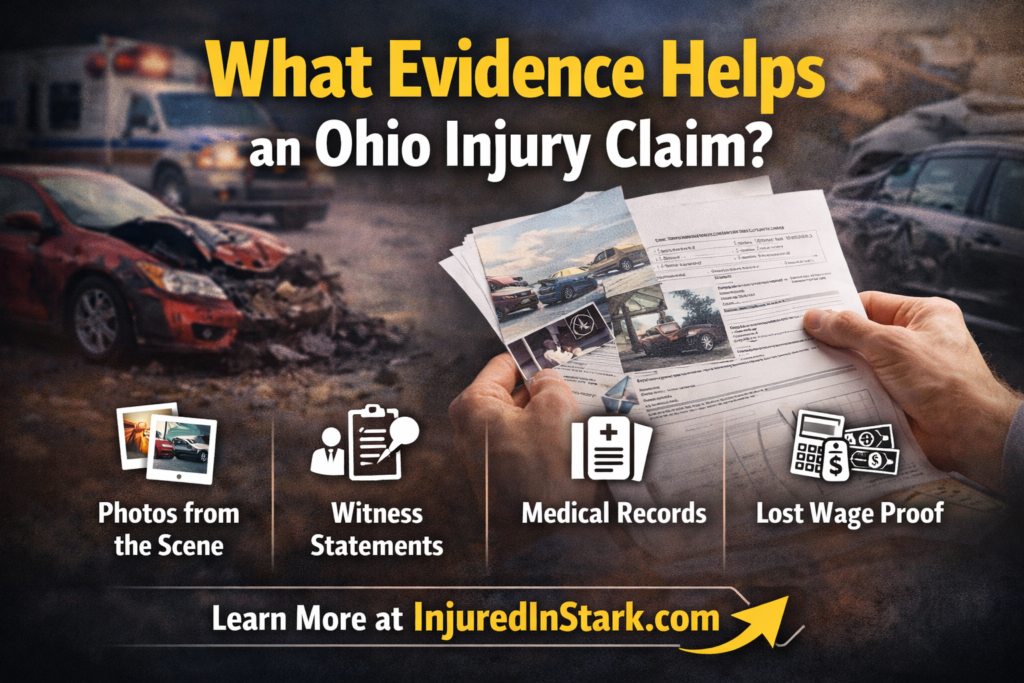
When it is safe to do so, consider photographing:
- Damage to each vehicle, bicycle, motorcycle, or other property involved;
- The location of the accident and the position of vehicles or other objects;
- Road defects, standing water, ice, snow, debris, lighting, signs, and traffic signals;
- Visible cuts, bruising, swelling, burns, or other injuries;
- Damage to clothing, safety equipment, or personal belongings; and
- Conditions at a business, residence, workplace, or other property where an injury occurred.
Take wide photographs that show the surrounding area as well as closer images of important details. Do not place yourself or anyone else in danger to obtain a picture. Keep the original files when possible, and avoid editing them in a way that changes what they show. If nearby security cameras, doorbell cameras, or traffic cameras may have recorded the event, make a note of their location. Video may be overwritten, so identifying it promptly can matter.
Witness Information May Support Your Account
A witness may provide useful information when the people involved remember the event differently. Someone who saw a collision, a hazardous condition, a fall, or what happened immediately afterward may be able to describe facts that are difficult to establish through photographs alone.
If a witness is willing, obtain the person’s name and contact information. Write down what the witness said while the conversation is fresh, but do not pressure the person to adopt particular wording or speculate about facts they did not observe. Police officers, responding emergency personnel, property managers, and employees may also have information about the event. Keep any incident number or report information you receive.
Witness evidence is most useful when it is based on firsthand knowledge. A person who arrived later may not have seen the accident itself, but that person may still be able to describe your condition, statements, or the scene immediately afterward.
Medical Records Connect the Accident to the Injury
Medical evidence helps document what was diagnosed, what treatment was recommended, and how your condition changed over time. Depending on the circumstances, relevant records may include emergency medical services reports, emergency department records, diagnostic imaging, physician notes, specialist evaluations, physical therapy records, prescriptions, and follow-up instructions.
Seek appropriate medical care after an accident, especially if you have pain, limited movement, numbness, dizziness, or other symptoms. Some injuries are not obvious immediately. Tell your healthcare provider what happened, identify the symptoms you are experiencing, and follow the provider’s instructions. If symptoms change, communicate that change rather than assuming it is unimportant.
Medical records should accurately describe your condition. Do not exaggerate symptoms, but do not leave out problems because they seem minor or inconvenient to mention. Treatment gaps can raise questions about the injury or recovery, although there may be many legitimate reasons a person misses an appointment. Keep explanations for missed appointments and save bills, insurance statements, receipts, and mileage or transportation information related to care.
For additional information about documenting treatment expenses, see medical bills after a car accident in Ohio.
Employment and Financial Records Show Economic Loss
An injury may affect more than medical expenses. If you miss work, lose scheduled hours, cannot perform certain duties, or use paid time off because of the injury, employment records may help document the effect. Potentially useful records can include:
- Pay statements from before and after the accident;
- Timekeeping records and documentation of missed shifts;
- Employer statements confirming dates or hours missed;
- Records showing reduced hours or changed job duties; and
- Tax or business records, when self-employment or business income is involved.
Do not assume that an informal estimate of lost income will be enough. Ask your employer about available documentation, and keep copies of what you provide to an insurer or another party. If your injuries affect your ability to work in the future, that issue may require additional medical and employment information rather than a simple calculation based only on missed days.
Our related article, who pays lost wages after a car accident in Ohio, discusses documentation that may be relevant to income loss.
Your Personal Notes Can Explain the Impact of an Injury
Records created by doctors and employers do not always capture what happens between appointments. A daily or weekly journal may help you remember pain levels, sleep problems, mobility limits, medication effects, household tasks you could not complete, activities you had to stop, and the emotional or practical effect of the injury. These notes are most useful when they are dated, accurate, and written consistently rather than prepared all at once long afterward.
You may also want to preserve calendars, canceled plans, photographs showing changes in your routine, and messages about transportation or assistance. This information does not replace medical proof, but it can provide context for how an injury affected ordinary life. Keep your notes private and factual. Do not use them to guess about legal conclusions or repeat unverified information.
Evidence Can Help Establish Responsibility
Proof of an injury alone does not explain why another person, business, or organization may be legally responsible. Evidence about responsibility depends on the type of incident. In a car accident, it may include photographs, witness accounts, vehicle damage, roadway information, citations, the crash report, and available video. In a premises case, photographs of the condition, notice or inspection records, incident reports, and information about how long a hazard existed may be relevant. Other claims may require different evidence.
Do not assume that a police report or incident report resolves every issue. Reports can be useful, but they may contain limited information and may not include medical records, later-discovered evidence, or every witness account. Preserve the report and compare it with your own records. If you believe another party may share responsibility, a lawyer can help identify what additional information may be important.
Ohio’s laws address issues that can affect personal injury claims, including responsibility and available remedies. The Ohio Revised Code is an official source, but applying a statute to a particular accident requires reviewing the facts and the potentially relevant law.
Save Communications and Be Careful With Social Media
Keep emails, letters, claim numbers, text messages, estimates, and notes from calls with an insurance company or another involved party. Record the date of each communication and the name of the person you spoke with. Do not discard voicemails or notices, even if they seem routine.
An insurer may request a recorded statement, medical authorization, inspection, or other information. Read what you are asked to sign and understand what is being requested before agreeing. Be truthful in every communication, but avoid guessing when you do not know an answer. You generally do not need to debate fault or describe the full value of a claim during an initial call. If you are unsure how to respond, consider getting legal guidance before providing a recorded statement or signing documents.
Social media posts, photographs, comments, and private messages may also become relevant if they appear to contradict an injury claim or description of daily limitations. Review your privacy settings, but do not assume that a private account prevents every post from being requested or used. Do not delete or alter potentially relevant material after an accident. Ask a lawyer about preservation if you are concerned about what should be retained.
Organize the Evidence Without Changing It
Create a secure folder for photographs, reports, medical records, bills, wage information, correspondence, and notes. Use descriptive file names and keep a simple timeline with the date of the accident, medical visits, work absences, communications, and significant changes in your condition. Save original photographs and videos separately from copies you send to someone else.
Do not repair, discard, sell, or modify damaged property before considering whether it may be relevant evidence. If repair is necessary, photograph the damage first and keep estimates, invoices, and replaced parts when practical. Do not contact a witness repeatedly or ask someone to change a statement. Preserving evidence means keeping an accurate record, not creating evidence that did not exist.
When Legal Guidance May Help
Evidence questions can become more complicated when fault is disputed, multiple people or insurers are involved, injuries continue, records are missing, or an insurer asks you to accept a settlement. The strength of a claim cannot be determined from one photograph or one medical bill. It usually depends on how the available evidence fits together and what information is still needed.
Slagle & Kotnik represents injured people and families in Massillon, Canton, Stark County, and surrounding Ohio communities. Learn more about our Personal Injury representation and contact the firm to discuss the evidence and questions involved in your situation. General information cannot replace advice about your particular claim.
Talk With Slagle & Kotnik
If you have questions about an Ohio injury claim or how to preserve evidence after an accident, contact Slagle & Kotnik for a free consultation.