
A workplace injury can raise more than one legal question. You may need medical care, time away from work, and information about workers’ compensation. You may also wonder whether someone other than your employer contributed to the accident.
In some situations, an injured worker may have a potential claim against a third party. A third party is someone or a business outside the employer-employee relationship who may have caused or contributed to the injury. Examples can include a negligent driver, a property owner, a contractor, an equipment company, or another business working at the same location.
A third-party claim is different from a workers’ compensation claim. The two may involve different parties, different evidence, and different types of losses. Understanding that distinction can help you identify the questions to ask after an injury in Massillon, Canton, Stark County, or elsewhere in Ohio.
This article provides general information, not personalized legal advice. The facts of the accident and the parties involved will determine what options may exist.
What Is a Third-Party Workplace Injury Claim?
A third-party workplace injury claim is a civil claim against a person or business that was not your employer but may have caused or contributed to your injury. The claim generally focuses on the third party’s conduct, property, equipment, or other responsibility connected to the accident.
For instance, imagine that a worker is driving between job sites and another motorist causes a collision. The worker may need to pursue workers’ compensation-related benefits for the workplace injury while also examining whether the other driver may be responsible for the crash.
Other possible situations may involve:
- A contractor leaves a dangerous condition at a worksite.
- A property owner fails to address a hazardous area where an employee must work.
- A delivery driver or other motorist causes a crash involving a worker.
- Defective or poorly maintained equipment contributes to an injury.
- Another company’s employee creates an unsafe condition during shared work.
These examples do not mean a claim exists in every similar situation. Responsibility depends on the evidence, the relationships among the parties, and the circumstances of the accident.
How Is a Third-Party Claim Different From Workers’ Compensation?
Workers’ compensation and a third-party civil claim serve different purposes. Workers’ compensation is connected to a workplace injury and may involve medical treatment and other benefits under the applicable system. A third-party claim is directed at an outside person or business whose conduct may have played a role in causing the injury.
The distinction matters because the legal issues are not identical. A workers’ compensation process may focus on whether the injury occurred in connection with employment and what benefits may apply. A third-party claim may require evidence concerning negligence, unsafe property, defective equipment, or another legal theory.
Workers’ compensation questions can also arise even when a third-party claim is being considered. An injured worker should not assume that filing one type of claim automatically resolves the other. The claims may involve different forms, communications, investigations, and deadlines.
Ohio workers can review the Ohio Bureau of Workers’ Compensation information about the First Report of Injury. The form and reporting process are only part of the larger picture, so workers should consider getting guidance about their specific circumstances.
For a broader overview, see our article on whether you can sue after a workplace injury in Ohio.
Who Might Be a Third Party?
The identity of a possible third party is not always obvious immediately after an accident. A worksite may include several companies, property owners, vendors, drivers, maintenance providers, and equipment suppliers. Each may have a different role and different records.
Another driver
Motor vehicle crashes are a common setting for questions about third-party responsibility. A worker may be injured while driving for work, loading a vehicle, standing near a work vehicle, or traveling through a work area. The other driver, the driver’s employer, or another responsible entity may need to be investigated based on the facts.
A property owner or manager
An employee may be injured at a location controlled by a customer, landlord, business, or other property owner. A dangerous floor, stairway, lighting condition, walkway, or other property condition may raise questions about who knew about the hazard and who had responsibility for addressing it.
A contractor or subcontractor
Construction sites and commercial projects often involve multiple companies. One company may control the work area while another performs a specialized task. If a worker is injured because of another company’s conduct, the contracts, work assignments, safety procedures, and site records may become important.
An equipment manufacturer or maintenance company
Machinery, tools, vehicles, lifts, and other equipment can create complicated questions after an accident. Investigators may need to determine whether the equipment was defective, improperly maintained, incorrectly installed, or used in an unsafe way. Preserving the equipment and related records can be especially important.
What Must Be Shown in a Third-Party Claim?
The exact elements depend on the legal theory and the facts. In a negligence-based claim, the investigation may examine whether the third party had a responsibility to act reasonably, failed to do so, and caused the injury. The analysis may also consider whether the injury and claimed losses are connected to the event.
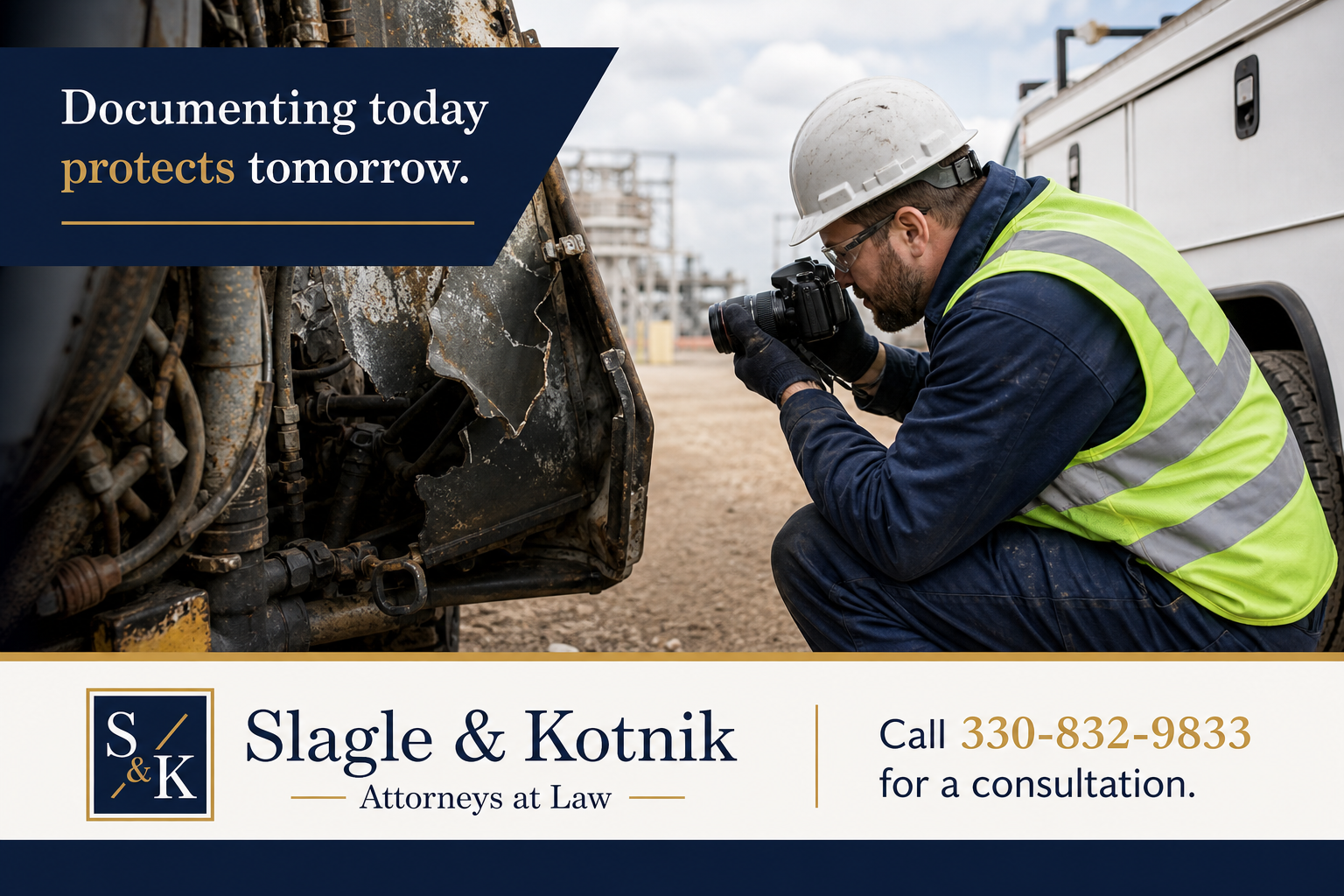
Evidence can be central. A person may remember the accident clearly, but memories can change over time. Physical conditions may be repaired, vehicles may be moved, electronic records may be overwritten, and witnesses may become difficult to locate.
Useful evidence may include:
- Incident reports and workplace safety reports.
- Photographs or video of the location, vehicles, equipment, and visible injuries.
- Names and contact information for witnesses.
- Vehicle data, photographs, insurance information, and police records after a crash.
- Work orders, inspection records, maintenance logs, and safety materials.
- Contracts or records showing which company controlled a work area or task.
- Medical records connecting the injury to the accident.
- Pay records and information about missed work or work restrictions.
Our guide to evidence that may help a personal injury claim in Ohio discusses documentation in more detail.
What Should You Do After a Workplace Injury?
Get prompt medical attention
Your health should come first. Seek appropriate medical care and tell the provider how the injury happened. Follow the treatment instructions you receive, and keep records of appointments, restrictions, prescriptions, therapy, and symptoms.
Report the injury through the proper workplace process
Tell the appropriate supervisor, manager, or workplace contact as soon as reasonably possible. Keep a copy of any report or written notice when possible. If the injury involves several companies, identify each company present at the location and the role each appeared to have.
Preserve information
Save photographs, messages, emails, work instructions, names of witnesses, and documents related to the accident. Do not throw away damaged equipment, clothing, protective gear, or other items that may help show what happened. If preserving an item is difficult, photograph it and ask about the next step before altering or discarding it.
Be careful with recorded statements
An insurer, another company, or an investigator may ask for a statement soon after the injury. You should be truthful, but it is reasonable to understand who is requesting the statement, what role that person has, and how the statement may be used. Avoid guessing about details you do not know.
Do not overlook other responsible parties
Do not assume that your employer is the only possible source of information or responsibility. Ask who owned the property, who controlled the work area, who supplied or maintained the equipment, and whether another vehicle or company was involved.
How Can a Third-Party Claim Affect Benefits or Insurance?
When a workplace injury involves a possible third party, more than one insurance system may become involved. Workers’ compensation may address certain employment-related benefits, while an outside insurer may investigate a civil claim. Health insurance, auto insurance, commercial insurance, and other coverage may also appear in the records.
Those overlapping claims can create practical complications. An insurer may ask questions about who paid medical expenses. A benefits provider may assert an interest in money recovered from another source. The injured worker may also receive forms or communications that use different descriptions of the accident.
Keep every letter, email, bill, form, and payment explanation. Do not assume that an insurance company’s position is a complete determination of your rights. Reviewing the communications with an Ohio injury attorney can help clarify which issues require attention.
Why Timing and Investigation Matter
A workplace accident may seem straightforward at first. Later, important questions can emerge: Was a warning provided? Who inspected the equipment? Was the driver working for a company? Did a contractor control the area? Were there earlier complaints about the condition?
Answers may be found in records held by people or businesses other than your employer. Those records may not be available forever. Surveillance footage can be overwritten, equipment can be repaired, and companies may change contractors or work procedures.
It is also important to understand that different claims can have different time requirements. This article does not provide a deadline for a particular claim. A delay can make evidence harder to locate, so speaking with counsel early may help you understand the issues that need investigation.
Questions to Ask When Evaluating a Possible Claim
If you were injured while working, consider gathering answers to these questions:
- Where did the injury happen?
- What task were you performing?
- Which companies, drivers, contractors, or property owners were involved?
- Who controlled the location, equipment, vehicle, or work assignment?
- Were there witnesses, cameras, inspection records, or written safety instructions?
- Did you report the injury, and what documents were created?
- What medical treatment and work restrictions followed?
- Have an insurer, employer, contractor, or investigator asked for a statement?
You do not need to know the legal answer to every question before seeking help. A clear timeline and organized documents can give an attorney a better starting point for evaluating what happened.
When Should You Speak With an Ohio Injury Attorney?
Consider contacting an attorney when a workplace injury involves a serious medical condition, disputed responsibility, multiple companies, a motor vehicle crash, damaged equipment, or uncertainty about available claims. Legal questions can also arise when an insurer asks for a recorded statement or when medical and wage losses continue.
Slagle & Kotnik represents injured people and families in Massillon, Canton, Stark County, and surrounding Ohio communities. Contact the firm at 330-832-9833 or lslagle@slaglekotniklaw.com to discuss your situation and request a free consultation.
Conclusion
A workplace injury may involve more than a workers’ compensation process. If a driver, contractor, property owner, equipment company, or another outside party contributed to the accident, a separate third-party claim may need to be considered.
Prompt medical care, accurate reporting, careful documentation, and early attention to possible evidence can help preserve important information. Since each workplace accident is different, obtain advice based on the specific facts rather than assuming that one process answers every question.
Talk With Slagle & Kotnik
If you have questions about an Ohio legal matter, contact Slagle & Kotnik in Massillon to discuss the situation and the options that may be available.
Learn more about our Accident representation.