Are Things You Ask AI Protected by Attorney-Client Privilege?
More people now use AI before they call a lawyer. They ask about car accidents, insurance claims, work injuries, contracts, criminal charges, and other legal problems. That may feel quick and private. Still, it can create real risk.
In general, you should not assume that something you type into an AI chatbot is protected by attorney-client privilege. A recent federal case, United States v. Heppner, is one reason lawyers are warning people to be careful.
⚖️ Why AI Is Not the Same as Talking to a Lawyer
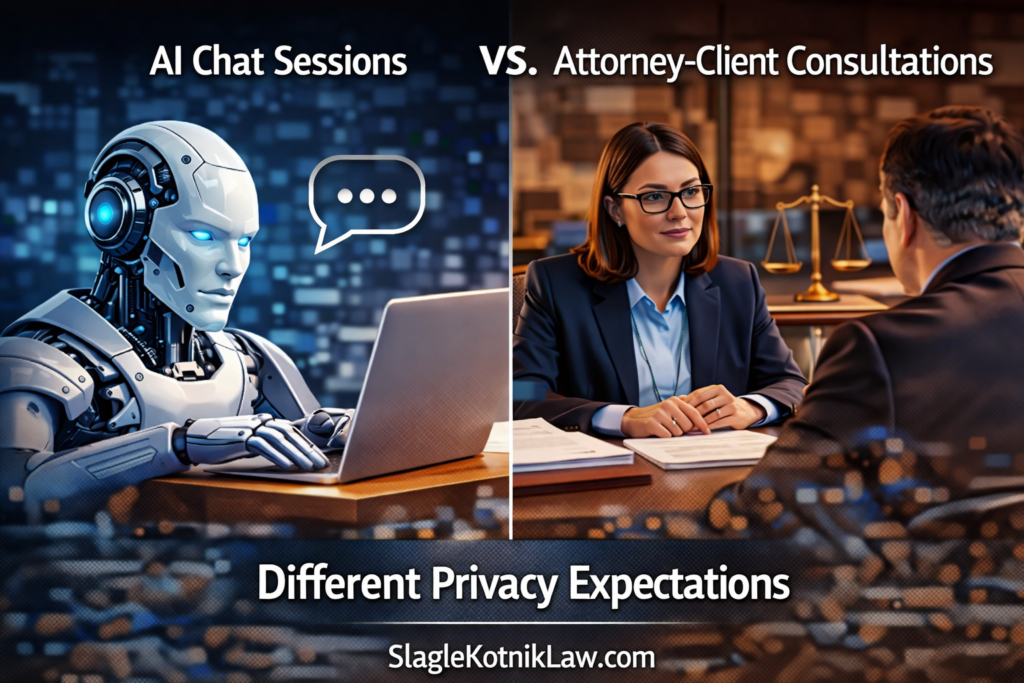
Attorney-client privilege exists to protect confidential communications between a lawyer and a client made for the purpose of getting legal advice. By contrast, a general AI platform is not your lawyer, does not automatically create an attorney-client relationship, and may involve a third-party system processing what you type.
That difference matters. If you put the facts of your case into a public or consumer AI tool, a court may later view that as disclosure outside the protected lawyer-client relationship. In other words, a chat with AI is not the same as a confidential conversation with legal counsel.
🛡️ The Common Mistake: Thinking “Private” Means “Privileged”
Many people assume that if a website has a login or feels secure, their messages must be privileged. That is not how privilege works.
A system may have privacy settings. It may advertise security. It may even promise not to use your data in certain ways. Even so, that does not automatically turn an AI chat into a privileged legal communication. Privilege depends on the legal relationship, the purpose of the communication, and whether confidentiality was maintained in a way the law recognizes.
📋 Even Future Clients Should Be Careful
Some people think privilege only matters after they hire a lawyer. That is too simple. In some situations, a person speaking with a lawyer as a potential client may still receive certain protections. However, that applies to discussions with an actual lawyer, not to a general AI chatbot.
So if you think you may have a claim, the safer move is usually to contact a real attorney rather than test your facts by typing them into AI first.
🚫 What You Should Not Put Into AI
As a practical matter, people should be very cautious about entering sensitive legal facts into AI. That includes admissions of fault, private medical details, settlement strategy, criminal defense concerns, and documents they plan to share with counsel.
For example, broad educational questions are one thing. Case-specific facts are another. It is much safer to ask general questions than to upload records, describe possible wrongdoing in detail, or seek advice based on confidential documents.
🤖 AI Can Help With General Information, But It Has Limits
AI may be useful for learning basic legal terms, making a list of questions for a lawyer, or getting general background information. Even so, it should not be treated as a secure place to share the full facts of a legal problem.
If you want helpful legal information after an injury, you can also review resources at Injured in Stark. Still, general information is not the same as confidential legal advice from an attorney who knows your case.
📞 The Safer Choice Is To Speak With a Lawyer
If you have been injured, accused of wrongdoing, contacted by an insurer, or pulled into a legal dispute, do not assume an AI chatbot is a safe place to share the full facts.
AI can be useful for general background information. It is not a substitute for confidential legal advice. If you need advice about your rights or your case, contact Slagle Kotnik Law and speak directly with an attorney.